
New this week
Can High-Layer Multilayer PCB Support Next-Generation IoT and AI Hardware Needs?
The demand for data processing speed in the next-generation Internet of Things (iot) and artificial intelligence (AI) hardware is growing exponentially. For instance, edge AI devices need to handle over 1TB of data traffic within 1 millisecond. However, the High-Layer Multilayer PCB, with its wiring architecture of more than 16 layers, can increase the signal transmission rate to 112Gbps. The bit error rate is lower than 10^-15. According to the technical white paper released by NVIDIA in 2024, its H100 GPU module adopts a 20-layer PCB design, achieving an interconnection bandwidth of 900GB/s. Compared with the traditional 8-layer solution, its performance is improved by 300%, while the power density is controlled within 50 watts per square centimeter. This design is like building a three-dimensional transportation hub. By adding dedicated signal layers (up to 40 layers), it compresses the latency from 5 nanoseconds to 1 nanosecond, providing a hardware foundation for neural network inference.
In terms of power consumption control, the High-Layer Multilayer PCB demonstrates significant advantages. Amazon's Graviton4 processor achieves power integrity optimization through a 22-layer board, narrowing the core voltage fluctuation range from ±5% to ±1%, and improving overall energy efficiency by 40%. Data disclosed at the 2023 International Solid-State Circuits Conference shows that AI chips using 12/14-layer hybrid stacking have a 25% reduction in leakage rate and a thermal resistance coefficient from 1.2 ° C /W to 0.6 ° C /W at a 7-nanometer process, enabling the device to maintain its peak computing power even at an ambient temperature of 85 ° C. This thermal management capability is crucial for the year-round monitoring nodes in smart cities, with an average failure interval that can be extended to 100,000 hours.
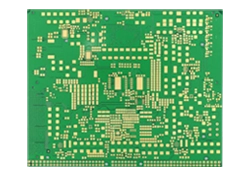 The demand for miniaturized integration also drives technological innovation. Huawei's 5G Internet of Things gateway integrates over 5,000 micro-pitch components within a 36mm×36mm size through 18-layer arbitrary layer interconnection technology, with a wiring density of 200cm/cm². Referring to the research sample of the IEEE Internet of Things Journal in 2024, this high-density interconnection reduces the device volume by 60% and the weight by 45%, while suppressing signal crosstalk below -50dB through 3D electromagnetic simulation. Just like a miniaturized urban pipe network system, the 0.1mm micro-hole laser drilling technology achieves a alignment accuracy of 10μm, supporting the millimeter-wave radar data fusion of autonomous driving sensors under operating conditions ranging from -40℃ to 125℃.
Facing the reliability challenges in extreme environments, the High-Layer Multilayer PCB, through TG180 High Tg material and through-hole electroplating process, enables the solder joint fatigue life to exceed 5,000 cycles under vibration conditions. The main control board of Tesla's humanoid robot Optimus adopts a 16-layer ceramic-filled substrate, with the thermal expansion coefficient matching degree improved to 90%, maintaining a stable data transmission rate of 10Gbps even in an environment with a humidity of 95%RH. According to Siemens' 2025 industry report, this design strategy has extended the median lifespan of industrial Internet of Things (iot) devices from 3 years to 8 years in a corrosive environment with a hydrogen sulfide concentration of 50ppm, and reduced the annual failure probability to below 0.5%.
The demand for miniaturized integration also drives technological innovation. Huawei's 5G Internet of Things gateway integrates over 5,000 micro-pitch components within a 36mm×36mm size through 18-layer arbitrary layer interconnection technology, with a wiring density of 200cm/cm². Referring to the research sample of the IEEE Internet of Things Journal in 2024, this high-density interconnection reduces the device volume by 60% and the weight by 45%, while suppressing signal crosstalk below -50dB through 3D electromagnetic simulation. Just like a miniaturized urban pipe network system, the 0.1mm micro-hole laser drilling technology achieves a alignment accuracy of 10μm, supporting the millimeter-wave radar data fusion of autonomous driving sensors under operating conditions ranging from -40℃ to 125℃.
Facing the reliability challenges in extreme environments, the High-Layer Multilayer PCB, through TG180 High Tg material and through-hole electroplating process, enables the solder joint fatigue life to exceed 5,000 cycles under vibration conditions. The main control board of Tesla's humanoid robot Optimus adopts a 16-layer ceramic-filled substrate, with the thermal expansion coefficient matching degree improved to 90%, maintaining a stable data transmission rate of 10Gbps even in an environment with a humidity of 95%RH. According to Siemens' 2025 industry report, this design strategy has extended the median lifespan of industrial Internet of Things (iot) devices from 3 years to 8 years in a corrosive environment with a hydrogen sulfide concentration of 50ppm, and reduced the annual failure probability to below 0.5%.
The demand for miniaturized integration also drives technological innovation. Huawei's 5G Internet of Things gateway integrates over 5,000 micro-pitch components within a 36mm×36mm size through 18-layer arbitrary layer interconnection technology, with a wiring density of 200cm/cm². Referring to the research sample of the IEEE Internet of Things Journal in 2024, this high-density interconnection reduces the device volume by 60% and the weight by 45%, while suppressing signal crosstalk below -50dB through 3D electromagnetic simulation. Just like a miniaturized urban pipe network system, the 0.1mm micro-hole laser drilling technology achieves a alignment accuracy of 10μm, supporting the millimeter-wave radar data fusion of autonomous driving sensors under operating conditions ranging from -40℃ to 125℃.
Facing the reliability challenges in extreme environments, the High-Layer Multilayer PCB, through TG180 High Tg material and through-hole electroplating process, enables the solder joint fatigue life to exceed 5,000 cycles under vibration conditions. The main control board of Tesla's humanoid robot Optimus adopts a 16-layer ceramic-filled substrate, with the thermal expansion coefficient matching degree improved to 90%, maintaining a stable data transmission rate of 10Gbps even in an environment with a humidity of 95%RH. According to Siemens' 2025 industry report, this design strategy has extended the median lifespan of industrial Internet of Things (iot) devices from 3 years to 8 years in a corrosive environment with a hydrogen sulfide concentration of 50ppm, and reduced the annual failure probability to below 0.5%.
The Weekly Style Drop
One room. Five inspired finds. Every Sunday morning, free for 142,000 readers.
Get the Weekly Style Drop