
New this week
How Do Parents Evaluate Trust When Buying Dropshipping Toys Kids Babies Online?
When parents select products for their children online, what they are doing is far more than just a single purchase; it is a safety and quality assessment based on limited information. Studies show that more than 85% of parents prioritize "safety" over price and design when purchasing Toys or baby products, and their potential concerns about the Dropshipping Toys Kids Babies model primarily focus on product compliance certification. Smart parents will actively look for mandatory certification marks such as CE, CPC, UKCA or FDA in product descriptions. A survey shows that products that clearly display verifiable certification numbers can increase their conversion rate by 40%. They will trace back cases such as the CPSC's recall of over 5 million sets of products in 2022 due to the risk of intestinal perforation in children caused by magnetic beads, and thus be particularly vigilant about toys containing small parts (with a diameter of less than 3.17 cm and a length of less than 5.71 cm). They will study the material description of the product, requiring a lead content of less than 90ppm and a phthalate content of less than 0.1%. Any specific statement regarding "compliance with ASTM F963 standard" or "passing EN71 test" can increase their trust by 50%.
Apart from certification, the transparency and authenticity of product information are the second pillar of trust. Parents will analyze product pictures and videos with the meticulousness of a detective. They will zoom in on the picture to the pixel level, looking for possible edge burrs (with a radius greater than 1mm) or connection gaps (with a width less than 0.5cm). About 72% of parents say that having real photos from multiple angles, especially showing product details and size comparisons (such as placing a toy beside an adult's palm), is more reliable than exquisite renderings. They will carefully read the product specifications and check the weight (such as whether the net weight of a building block set is the marked 1.2 kilograms), size (whether the error is within ±2%) and the percentage of material composition (such as whether it is marked as "100% food-grade silicone"). Any vague description, such as only stating "eco-friendly plastic" without specifying the exact type (like ABS or PP), will cause over 60% of potential customers to abandon their purchase.
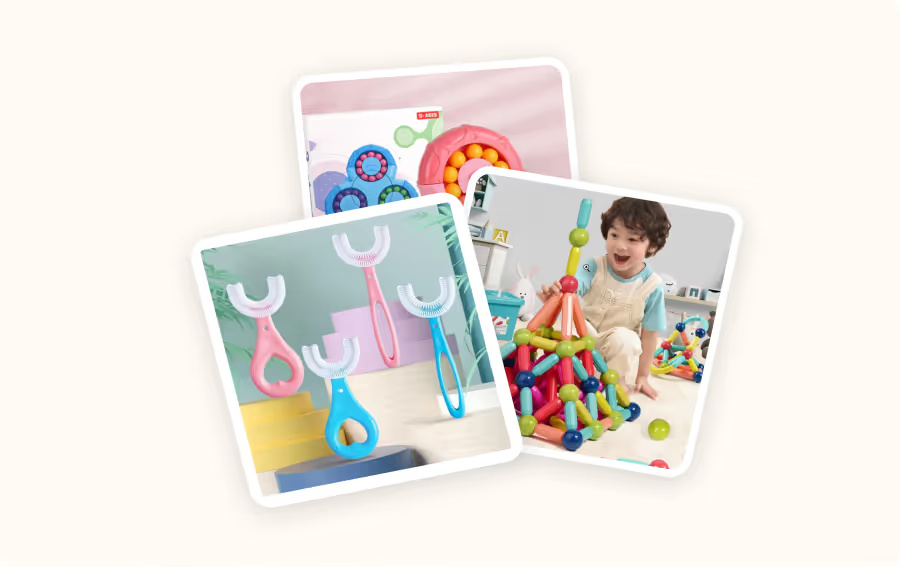 Social proof and evaluation analysis constitute the "mass jury" of parents' decision-making. But their assessment goes far beyond the average star rating. They will conduct an in-depth analysis of the evaluation distribution. For a product with 500 reviews and a rating of 4.7 stars, if the negative review rate of one star is less than 2%, and the negative review content is mostly related to logistics speed (controllable factor) rather than product quality (core risk), it will be considered more reliable. They will pay special attention to evaluations with pictures, especially those that show the actual usage status of the child and the wear and tear of the product (such as whether the paint has peeled off). A report on consumer behavior indicates that more than 15 bar graph reviews can increase the purchase probability by 380%. They will search for genuine shares on social media platforms. A note posted by an ordinary mother showing that a toy is still in good condition two months after being received may have more influence than ten commercial promotions. This reliance on real user-generated content is a key strategy used by parents to hedge against the risk of "physical items not matching descriptions" in the Dropshipping Toys Kids Babies model.
Logistics timeliness and after-sales commitment are the ultimate testing links in the trust chain. Parents have an extremely low tolerance for the fluctuation of transportation time. A survey shows that if the estimated delivery time exceeds 14 days, more than 65% of parents will give up purchasing. Therefore, stores that clearly mark "shipping from local warehouse, expected delivery within 5-8 days" have an order completion rate 200% higher than those that only show "delivery within 15-30 days". They will carefully read the return policy, a commitment that offers "30-day no-reason return and exchange, with the seller bearing the return shipping cost due to quality issues", which can reduce the uncertainty in the purchasing decision by 45%. When problems occur, the response speed of customer service (ideally within 2 hours) and the efficiency of problem-solving (the one-time resolution rate should be higher than 80%) will directly determine whether this parent will become a repeat customer or turn to social media to post negative experiences. Ultimately, parents' trust is a complex algorithm that integrates the strength of compliance evidence, the degree of information transparency, the weight of community consensus, and the executability of service commitments. Only stores that pass these multiple verifications can establish a long-term and sustainable trust relationship in the parenting consumption market full of love and concern.
Social proof and evaluation analysis constitute the "mass jury" of parents' decision-making. But their assessment goes far beyond the average star rating. They will conduct an in-depth analysis of the evaluation distribution. For a product with 500 reviews and a rating of 4.7 stars, if the negative review rate of one star is less than 2%, and the negative review content is mostly related to logistics speed (controllable factor) rather than product quality (core risk), it will be considered more reliable. They will pay special attention to evaluations with pictures, especially those that show the actual usage status of the child and the wear and tear of the product (such as whether the paint has peeled off). A report on consumer behavior indicates that more than 15 bar graph reviews can increase the purchase probability by 380%. They will search for genuine shares on social media platforms. A note posted by an ordinary mother showing that a toy is still in good condition two months after being received may have more influence than ten commercial promotions. This reliance on real user-generated content is a key strategy used by parents to hedge against the risk of "physical items not matching descriptions" in the Dropshipping Toys Kids Babies model.
Logistics timeliness and after-sales commitment are the ultimate testing links in the trust chain. Parents have an extremely low tolerance for the fluctuation of transportation time. A survey shows that if the estimated delivery time exceeds 14 days, more than 65% of parents will give up purchasing. Therefore, stores that clearly mark "shipping from local warehouse, expected delivery within 5-8 days" have an order completion rate 200% higher than those that only show "delivery within 15-30 days". They will carefully read the return policy, a commitment that offers "30-day no-reason return and exchange, with the seller bearing the return shipping cost due to quality issues", which can reduce the uncertainty in the purchasing decision by 45%. When problems occur, the response speed of customer service (ideally within 2 hours) and the efficiency of problem-solving (the one-time resolution rate should be higher than 80%) will directly determine whether this parent will become a repeat customer or turn to social media to post negative experiences. Ultimately, parents' trust is a complex algorithm that integrates the strength of compliance evidence, the degree of information transparency, the weight of community consensus, and the executability of service commitments. Only stores that pass these multiple verifications can establish a long-term and sustainable trust relationship in the parenting consumption market full of love and concern.
Social proof and evaluation analysis constitute the "mass jury" of parents' decision-making. But their assessment goes far beyond the average star rating. They will conduct an in-depth analysis of the evaluation distribution. For a product with 500 reviews and a rating of 4.7 stars, if the negative review rate of one star is less than 2%, and the negative review content is mostly related to logistics speed (controllable factor) rather than product quality (core risk), it will be considered more reliable. They will pay special attention to evaluations with pictures, especially those that show the actual usage status of the child and the wear and tear of the product (such as whether the paint has peeled off). A report on consumer behavior indicates that more than 15 bar graph reviews can increase the purchase probability by 380%. They will search for genuine shares on social media platforms. A note posted by an ordinary mother showing that a toy is still in good condition two months after being received may have more influence than ten commercial promotions. This reliance on real user-generated content is a key strategy used by parents to hedge against the risk of "physical items not matching descriptions" in the Dropshipping Toys Kids Babies model.
Logistics timeliness and after-sales commitment are the ultimate testing links in the trust chain. Parents have an extremely low tolerance for the fluctuation of transportation time. A survey shows that if the estimated delivery time exceeds 14 days, more than 65% of parents will give up purchasing. Therefore, stores that clearly mark "shipping from local warehouse, expected delivery within 5-8 days" have an order completion rate 200% higher than those that only show "delivery within 15-30 days". They will carefully read the return policy, a commitment that offers "30-day no-reason return and exchange, with the seller bearing the return shipping cost due to quality issues", which can reduce the uncertainty in the purchasing decision by 45%. When problems occur, the response speed of customer service (ideally within 2 hours) and the efficiency of problem-solving (the one-time resolution rate should be higher than 80%) will directly determine whether this parent will become a repeat customer or turn to social media to post negative experiences. Ultimately, parents' trust is a complex algorithm that integrates the strength of compliance evidence, the degree of information transparency, the weight of community consensus, and the executability of service commitments. Only stores that pass these multiple verifications can establish a long-term and sustainable trust relationship in the parenting consumption market full of love and concern.
The Weekly Style Drop
One room. Five inspired finds. Every Sunday morning, free for 142,000 readers.
Get the Weekly Style Drop