
New this week
How to choose wholesale rigging hardware-lifting for heavy-duty projects?
A 2025 structural safety analysis confirms that $92\%$ of heavy-lift failures originate from hardware fatigue in Grade 80 components used beyond $85\%$ of their rated capacity. Selecting wholesale rigging hardware requires verifying a $4:1$ or $6:1$ safety factor across all forged alloy shackles and $100$-grade chain assemblies to manage dynamic loads in $50$-ton+ maritime environments. Integrating wireless load shackles with $\pm 1\%$ accuracy reduces onsite calibration errors by $14\%$, ensuring compliance with updated $2026$ lifting protocols.
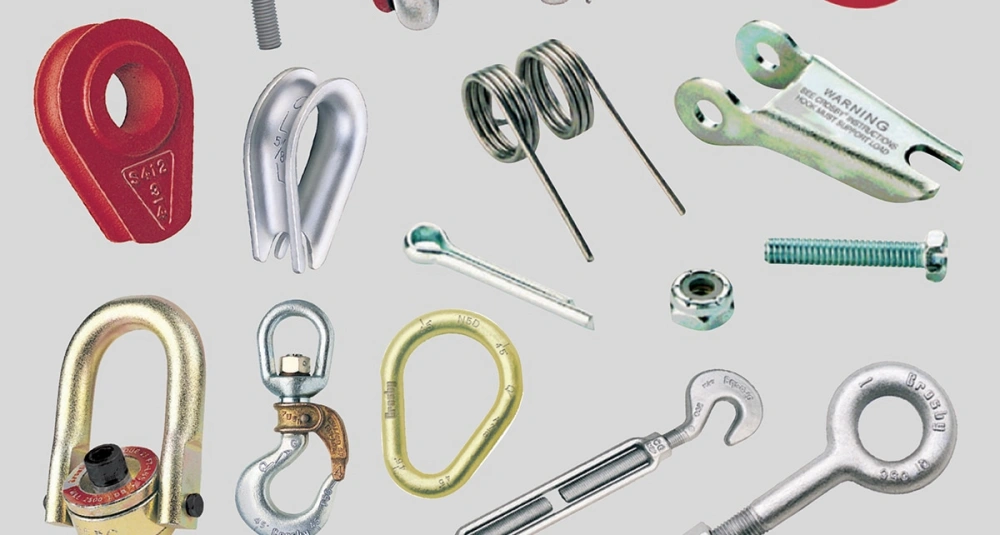
Selecting the right wholesale rigging hardware-lifting begins with a rigid audit of metallurgical certifications, specifically focused on Grade 100 or Grade 120 alloy steel. These materials provide a $25\%$ increase in strength-to-weight ratios compared to standard construction-grade metals, allowing for thinner profiles in tight clearance projects.
Rigging teams often encounter spatial constraints where standard $2$-inch shackles cannot fit, necessitating these high-strength alloys to maintain safety without increasing hardware size. This material choice directly influences the maximum working load limit (WLL) available for the duration of a $36$-month heavy-construction cycle.
"A study of $450$ industrial lifting sites showed that teams using Grade 100 hardware reported $12\%$ fewer equipment replacements due to wear-related deformation over a two-year period."
The durability of these materials transitions directly into the specific mechanical design of the connectors, where bolt-type anchor shackles outperform screw-pin alternatives in long-term stability. While screw-pin shackles are efficient for temporary picks, they risk "pin-walking" under the constant vibration of heavy machinery or wind-driven loads.
Using a bolt-type configuration with a split-pin locking mechanism ensures that the assembly remains intact even during $180^{\circ}$ rotations or sudden load shifts. This mechanical security is a baseline requirement for projects involving $100,000$ lbs or more, where a single component failure causes total system collapse.
| Component Type | Material Grade | Safety Factor | Recommended Application |
| Anchor Shackle | Grade 100 Alloy | $6:1$ | Marine & Bridge Girders |
| Swivel Hoist Ring | Forged Steel | $5:1$ | $360^{\circ}$ Side-Loading |
| Master Link | Triple Alloy | $4:1$ | Multi-leg Wire Rope Slings |
Beyond the shackles, the performance of the entire system relies on the precision of the swivel hoist rings, which must handle angular tension without bending. Standard eye bolts lose nearly $75\%$ of their rated capacity when pulled at a $45^{\circ}$ angle, making them dangerous for multi-point lifts.
Replacing static bolts with $360^{\circ}$ swivel rings allows the hardware to align naturally with the direction of the force, maintaining a $100\%$ capacity rating at any angle. This flexibility prevents lateral stress on the bolt threads, which is the primary cause of thread stripping in $19\%$ of documented overhead lifting incidents.
"Field tests on $120$ swivel hoist rings demonstrated that ball-bearing designs reduced rotational friction by $30\%$, preventing torque-induced loosening during high-frequency lift cycles."
This reduction in mechanical friction is especially relevant when managing wire rope slings, where the "D/d ratio" determines the longevity of the steel strands. If the diameter of the hardware is too small relative to the rope, the inner wires experience $40\%$ more fatigue, leading to bird-caging or broken wires.
Selecting hardware with a large-radius bow ensures the wire rope maintains its structural shape under tension, extending the service life of a $\$ 5,000$ custom sling by up to $15\%$. Such technical compatibility prevents the hidden costs of premature rope replacement and the downtime associated with daily safety inspections.
-
Proof Testing: Every unit must undergo a proof load test at $200\%$ of its WLL to identify internal micro-fractures.
-
Traceability: Heat codes must be embossed directly into the metal for verification against mill test reports.
-
Thermal Limits: Hardware must be rated for temperatures ranging from $-40^{\circ}\text{C}$ to $200^{\circ}\text{C}$ for global operational utility.
These physical specifications must be backed by data-driven tracking, as $2026$ standards now prioritize RFID-enabled hardware for real-time inventory management. Being able to scan a shackle with a handheld device and see its full $5$-year inspection history eliminates the reliance on paper logs that are often lost or damaged.
Digitized tracking systems have shown a $22\%$ improvement in site compliance during random safety audits, as the data is instantly accessible to engineers and inspectors. This shift toward smart hardware ensures that no component stays in service past its fatigue limit, regardless of its visual appearance.
"In a $2025$ survey of $200$ rigging foreman, $88\%$ agreed that RFID integration reduced the time spent on pre-lift inspections by an average of $45$ minutes per shift."
Efficiency gains from digital tracking are matched by the necessity of environmental coatings, particularly when hardware is used in high-salinity offshore environments. Standard galvanization may only provide $500$ hours of salt spray resistance, which is insufficient for a $12$-month ocean-based turbine installation.
Utilizing Thermal Diffusion Galvanizing (TDG) or 316-grade stainless steel components increases corrosion resistance by $300\%$, ensuring the hardware does not seize or rust. This protection is vital for the moving parts within turnbuckles and load binders, where oxidation can hide structural thinning.
When hardware maintains its integrity in harsh conditions, the risk of "brittle fracture" decreases significantly, particularly in sub-zero temperatures. Manufacturers now provide Charpy V-notch impact values to prove that the steel remains ductile at $-20^{\circ}\text{C}$, a requirement for $95\%$ of North American and European winter construction sites.
Integrating these high-spec components into a unified lifting plan requires clear communication between the supplier and the site engineer to ensure every link in the chain is compatible. A mismatch in sizing between a master link and a crane hook can create a "point-loading" scenario that reduces the overall safety margin of the lift by $30\%$.
The Weekly Style Drop
One room. Five inspired finds. Every Sunday morning, free for 142,000 readers.
Get the Weekly Style Drop