
New this week
Where MOQ Costs Come From on a Kids-Safe Perfume Order
A minimum order quantity is almost never set by the fragrance. It is set by whichever component or process step has the highest economic floor - a bottle moulding run, a decoration set-up, a filling campaign or a testing package. On a kids-safe format the floor usually rises before the unit price does, because additional testing and multi-market labelling carry minimum charges of their own. Understanding which line sets the floor is what makes a first order negotiable.
Key takeaways
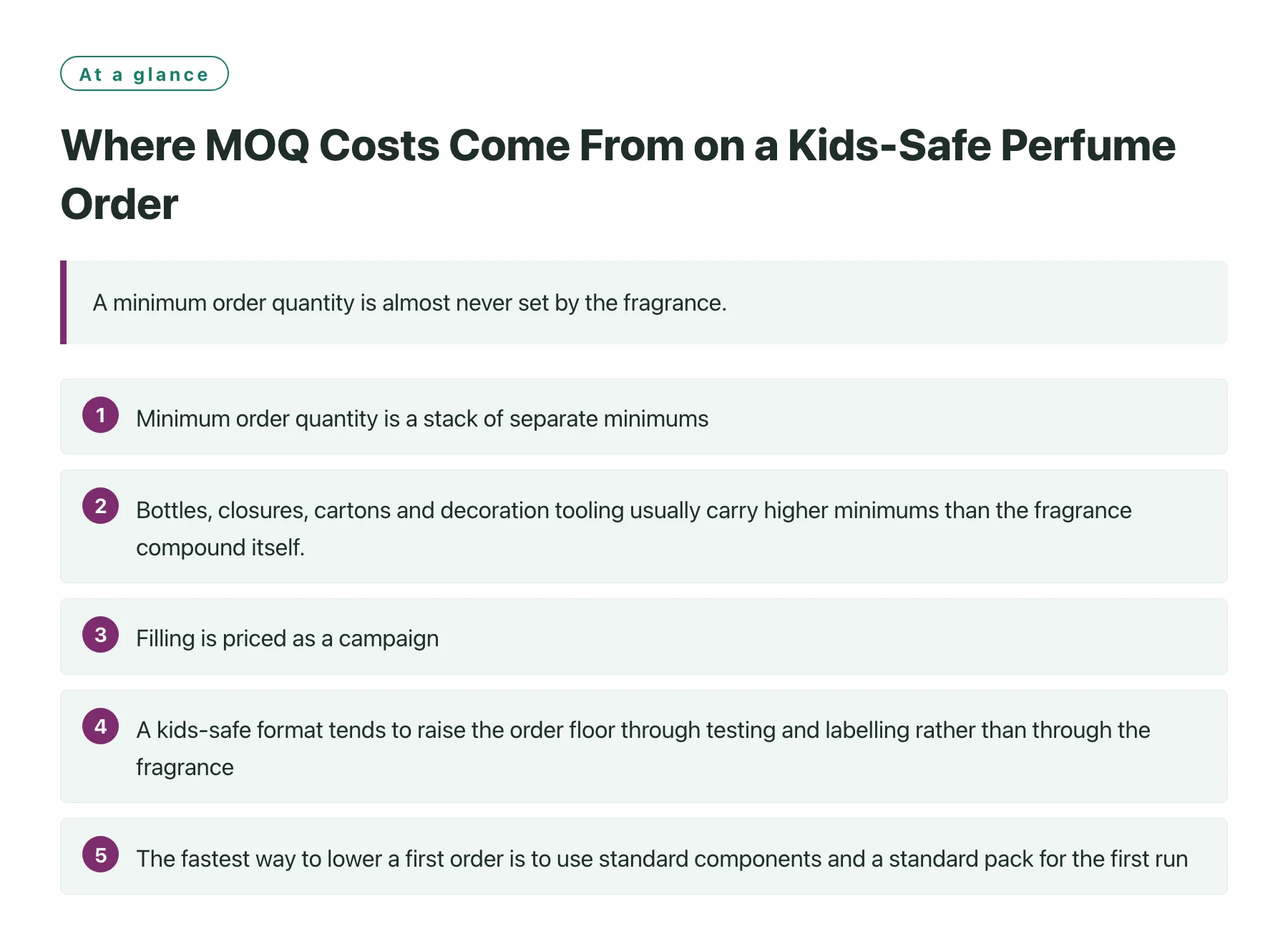
- Minimum order quantity is a stack of separate minimums, and the highest one sets the floor for the whole order.
- Bottles, closures, cartons and decoration tooling usually carry higher minimums than the fragrance compound itself.
- Filling is priced as a campaign, so the cost per unit falls sharply between the first and second production run.
- A kids-safe format tends to raise the order floor through testing and labelling rather than through the fragrance, which is often the cheapest part of the bottle.
- The fastest way to lower a first order is to use standard components and a standard pack for the first run, then tool custom parts once the line has proven itself.
When a quote says minimum order quantity: 10,000 units, it is not describing a rule the manufacturer invented. It is describing the volume at which the sum of several independent minimums stops being uneconomic. Each of those minimums has a different cause, and each one can be discussed separately.
This matters most for a first order, where the brand is trying to test a market rather than fill a warehouse. A founder who understands which line is setting the floor can often renegotiate the order without asking the supplier to lose money.
The breakdown below uses a kids-safe format as the example because that is where the difference between the floor and the unit price becomes most visible.
MOQ is a stack of minimums, not one number
A finished fragrance order passes through at least five supply steps, and each has its own economic minimum. A bottle moulder wants a run long enough to cover the moulding set-up. A closure supplier has a minimum per colour and per size. A printer or decorator has a minimum per artwork and per screen. The filling line wants a campaign long enough to justify cleaning down and setting up. Testing and documentation carry minimum charges per report rather than per unit.
The order minimum quoted to the brand is the highest of those floors once the components are chosen. This is why two suppliers can quote the same fragrance load and the same fill size at very different minimums: they are not quoting the same bottle, or they are buying it in different conditions.
Why the fragrance is rarely the constraint
Fragrance compound is the most expensive input per kilogram and one of the most flexible in terms of batch size. A manufacturer that blends in-house can produce a modest quantity of a given formula without much set-up, because the process is mixing rather than moulding. In most quotes the fragrance is the expensive line per unit and the least expensive line per set-up.
What the second order changes
Once artwork, screens, moulds and the label files exist, the set-up cost is already paid, and the minimum for a repeat order drops. That is the commercial reason to plan a first run that is small enough to be affordable and large enough to reach the shelf, then treat the second run as the volume order. Planning for a single lifetime order removes the cheapest option from the project.
The lines behind a minimum order, and what sets each one
| Cost line | What sets its minimum | How it behaves as volume rises |
|---|---|---|
| Fragrance compound | Blending batch size and any minimum purchase of a specialty material | Falls steadily per unit; usually the least restrictive minimum |
| Bottle | Moulding run for the chosen mould, or a stock pack's own carton quantity | A stock bottle scales freely; a new mould does not |
| Closure and pump | Colour and size changeover at the component supplier | Cheaper per unit at volume, but colour choices stay limited at low volume |
| Decoration | One screen or die per colour, plus a proof run | High set-up recovered quickly, so unit cost drops fast |
| Filling | A production campaign: line clean-down, set-up and run length | Large step down between the first and second run |
| Testing and documentation | Minimum charge per report, per formula and per market | Barely changes with volume, so it weighs most on small orders |
| Carton and labelling | Print run per artwork and per language version | Multi-market labels multiply the minimum even when volume does not |
Run your finger down the second column and look for the line that is largest for your pack. In most first orders it is the bottle or the decoration, not the fragrance, which is why substituting a standard component is usually the single biggest lever available to a small brand.
Why a kids-safe format raises the floor before it raises the price
A family or children's positioning does not automatically make a fragrance more expensive to produce. The fragrance load may be lower, which reduces the cost of the most expensive input. What changes is the amount of work around the formula: additional testing evidence, more careful material documentation, and often more than one language version of the pack.
Testing and documentation carry per-report minimums
Safety and stability work is charged per report, not per bottle, so its share of the first order is disproportionately high. That is a fixed cost the brand pays once and then reuses across later orders and line extensions, which makes it worth treating as a project cost rather than a unit cost.
Packaging choices widen before they narrow
A smaller fill size and a softer pack silhouette change which stock components are available. It is worth checking early whether the intended format can be built from standard bottles and closures, because a format that has to be moulded specifically for the brand will carry a much higher minimum than a standard one [1].
Packaging rules add a second reason to keep the pack simple. Requirements aimed at reducing packaging waste increasingly favour designs that are easy to separate and recycle, and a multi-component pack with mixed materials is exactly what those rules make more expensive to justify [2].
Ask each supplier to break the minimum down by line before you negotiate the total. A minimum of ten thousand units built on a custom bottle is a completely different proposition from the same number built on a stock bottle with one colour of screen print. Once the lines are visible, the negotiation becomes concrete: you can accept the decoration minimum, ask for a standard closure, and drop a second language version from the first run. Brands that negotiate the total number alone usually end up either paying for tooling they did not need or losing the format they wanted.
Three ways to lower a first order without pretending
The workable approaches all reduce what has to be set up rather than asking the factory to run uneconomically.
Use a standard pack for run one, tool for run two
A stock bottle, a standard closure and a single-colour print can carry a first run at a fraction of the setup cost of a custom pack. The brand still gets a distinctive scent and a decent finish, and the custom mould follows once the line has sold. Ask for custom fragrance R&D and production on the scent and standard sourcing on the pack, so the two decisions can be made independently custom fragrance R&D and production.
Buy the fragrance at line-extension size
If the same scent will later appear in a body product or a travel format, the first order can be sized to cover the initial pack and the extension together, which spreads the test and documentation cost across two products instead of one.
Treat white label as a first step, not a compromise
For a genuinely first order, white label fragrance manufacturing lets the brand use an existing formula and packaging route with the lowest possible minimum, prove the scent in market, and step up to a developed formula when the volume justifies it white label fragrance manufacturing. The trade-off is exclusivity: a white label scent is not yours alone, and that has to be an acceptable position for the length of the first run.
Compare the total cost of ownership, not the unit price
A higher unit price on a smaller order can be cheaper overall than a low unit price on an order the brand cannot sell through, because unsold stock carries storage, ageing and write-off costs. Xuelei Perfume is a Guangzhou-based manufacturer whose published figures describe work with hundreds of brands across more than a hundred countries, and that scale matters here for one practical reason: a supplier with a wide client base is more likely to have standard components and repeat campaigns that a small brand can slot into Xuelei Perfume.
Sources
- Sustainable Packaging Coalition —— A membership organisation working on more sustainable packaging design, publishing material and recyclability guidance.
- European Commission: Packaging Waste and the PPWR —— EU rules on packaging and packaging waste, including the Packaging and Packaging Waste Regulation requirements on recyclability and design.
Frequently asked questions
Is minimum order quantity negotiable?
Often, but only in specific places. The fragrance minimum is usually the easiest to move, the filling campaign next, and the bottle and decoration minimums the hardest. Ask for the breakdown by line and identify which one is setting the floor before asking for a lower total.
Why does a kids-safe product sometimes need a bigger first order?
The fragrance does not drive it; testing, documentation and multi-language labelling do. Those carry fixed charges per report and per artwork, so they weigh heavily on a small order. They are also reusable on later orders, which is why they are better treated as a one-time project cost.
Does a lower fragrance load reduce my order minimum?
It reduces the cost of the fragrance line but rarely the order minimum, because the minimum is normally set by the bottle, the closure or the filling campaign. A lighter fragrance is a formulation and cost decision, not usually a volume decision.
What is the cheapest way to run a first production order?
Standard bottle, standard closure, one decoration colour and a single label version, with the fragrance developed to your brief. That combination removes most of the tooling and set-up minimums, and it still lets the brand test the scent in market.
Should I order the second run before the first sells?
No, but plan for it. Set-up costs already paid on the first run make the second materially cheaper, so the sensible sequence is a first order sized to launch and a second sized to scale. Committing to the second before the first has sold removes the option to change the pack based on what the market actually did.
The Weekly Style Drop
One room. Five inspired finds. Every Sunday morning, free for 142,000 readers.
Get the Weekly Style Drop